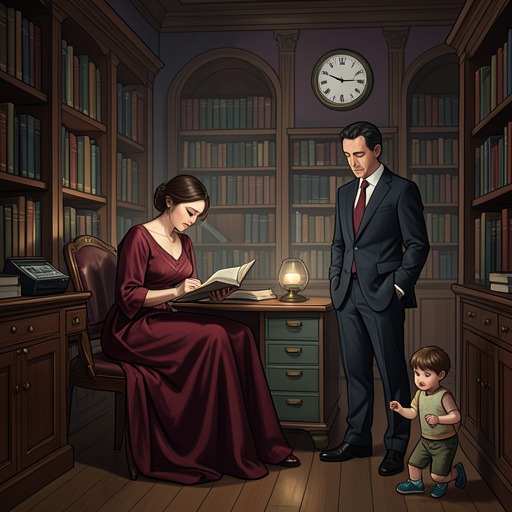
Women’s lack of agency
Just DesertsWomen’s lack of agency is not merely a personal frustration for Elizabeth Bennet but a structural force shaping family life, marriage, property, work, and social judgment. The women around her are expected to accept male-defined rules as “the way of the world,” even when those rules determine where they may live, whom they may marry, what they may own, and how their suffering will be judged. The novel’s central question is therefore not whether women can act, but how much meaningful control they can create inside systems that treat them as dependants, assets, or risks.
Early Recognition of a Gendered Order
Elizabeth’s resistance begins with questions. At thirteen, after menarche has ended her uncomplicated childhood, she notices that women are treated differently and as second-class citizens. Her five principal female influences—her aunt, Jane Bennet, Charlotte Lucas, Mrs. Hill, and her mother—cannot give her an explanation that satisfies her. Even the calmer women answer that gender hierarchy is simply the natural order, while Mrs. Bennet’s anxiety turns the question into another source of conflict. Elizabeth’s persistence matters because it refuses to mistake repetition for justification: “this was just the way of the world” describes the system’s endurance, not its fairness.
The entail makes that system materially immediate. Longbourn is directed away from the female line, and Elizabeth understands that her mother can bear no more children and that no son will appear to secure the estate. The threat of being “thrown into the hedgerows” drives Mrs. Bennet to press Jane into society at fifteen and to treat advantageous marriage as the family’s primary protection. Women’s futures are consequently made dependent on male succession, while daughters are positioned as the means by which security may be recovered through marriage.
Marriage, Law, and the Conversion of Women into Property
Edward Gardiner explains the legal structure with unusual patience. A woman is expected to move from her father’s home to her husband’s; before the age of twenty-one, Elizabeth requires her father’s consent to marry, and after marriage she has no independent rights under the law. Elizabeth experiences this as the reduction of a human being to “a thing, a piece of property.” Her objection is not simply that marriage may be unhappy. It is that the legal arrangement denies her the status of an autonomous decision-maker before the marriage even begins.
This is why Elizabeth’s refusal of William Collins is a direct challenge to the economic logic surrounding her. She insists that a bride cannot be forced to marry and that she will not be sold merely to preserve Longbourn. The refusal is framed against her mother’s greater attachment to the estate than to Elizabeth herself, making the marriage proposal a test of competing values: female consent and emotional reality on one side, property preservation and family panic on the other. Charlotte Lucas’s willingness to marry William Collins for a home and relief from dependence presents the contrasting adaptation. Her priorities are material rather than romantic, not because the novel treats her choice as simple foolishness, but because the system has made security an urgent female concern.
Reputation, Double Standards, and Social Punishment
Lady Radha Pentland gives Elizabeth a broader history of gendered judgment. Sir David Pentland is celebrated as a naval hero and knight, while Lady Radha has survived nearly ten years of crimes, abduction, enslavement, and a wound that is usually fatal. Yet once her survival becomes certain, she receives barbed comments and hears that it would have been better had she died. Her survival is treated as an embarrassment, and her supposed “original sin” is merely having lived close enough to the coast in India to be captured by slavers. The contrast exposes a social double standard in which male heroism is publicly honored while female survival is made a source of shame.
Lady Radha’s treatment also alters Sir David’s life. His uncertainty about continuing his naval career is intensified by the hostility directed at his wife; he resigns his commission, returns to Britain with her, converts—though superficially—to the Church of Scotland, and marries her near Edinburgh before settling at Grenadine Reef. Their marriage becomes an answer to a culture that has denied Lady Radha dignity: it treats her as a beloved partner rather than as a damaged body or a social inconvenience.
Elizabeth encounters a related, though less extreme, form of inequality in Meryton. She is angered when men display the assumption that gentlemen may escape consequences unavailable to women, while Caroline Bingley and Louisa Hurst behave as though their tradesman family places them above local shopkeepers and tradesmen. Elizabeth’s irritation joins class consciousness to gender consciousness. Women’s lives are already circumscribed; the performance of superiority by women who possess only limited social privilege reveals how hierarchy can be reproduced even by those constrained within it.
Female Labor as Practical Authority
The novel does not present agency only as public legal power. It also locates it in the undervalued labor through which homes, estates, businesses, and communities continue to function. Lady Radha teaches Elizabeth the lady’s role at Grenadine Reef through conversation and shared experience rather than formal instruction. Elizabeth gradually learns estate management, observes Lady Radha setting menus, and sees her act as Sir David’s helpmate across the full range of estate affairs. The lessons are relational and practical: authority is exercised through knowledge of people, provisions, obligations, and daily decisions.
Elizabeth’s visits also connect domestic management with social responsibility. Lady Radha explains that, from the first year at Grenadine Reef, the household has provided refuge for women abused by men, chiefly servants and daughters of tenants or tradesmen. These women may recover there and address the consequences of what has happened to them. Lady Radha listens without judging when survivors need to unburden themselves, rage against injustice, or narrate their experiences. The refuge therefore becomes a material alternative to a society that often converts female suffering into disgrace.
Elizabeth’s own usefulness expands through this education. Time with Sir David and correspondence with the Harkness sisters channel her energy into what she calls being “calmly active.” She studies estate management, writes letters, visits tenants, and becomes able to help Sir David recover through her intelligence, kindness, enthusiasm, and questioning nature. At the Gardiners’ home, she learns the maintenance and cleaning schedules, weekly menu planning, and the constraints involved in managing a household. Such work is conventionally treated as feminine duty, but the novel makes its knowledge visible as a form of competence that supports both wealth and welfare.
Her understanding of tenant relations is likewise learned through women’s experience and reciprocal instruction. Jane Bennet began tenant visits at twelve, with Elizabeth accompanying her at ten, and the tenants themselves taught the sisters how to help. Elizabeth later recognizes that Lady Radha’s lessons and her visits to Grenadine Reef made the Longbourn visits more efficient and less dependent on trial and error. The welfare of tenants is described as the estate master’s responsibility, yet the actual transmission of practical knowledge runs substantially through female observation, care, and labor.
From Constraint to Institutional Change
The limits imposed on women remain visible even when Elizabeth becomes central to the future of Grenadine Reef. Sir David grows frail and recognizes that the estate’s succession cannot simply be left to custom. When Vivian Harkness asks what will happen to the estate after his death, the question is considered improper for a servant, but it reveals the shared danger: the future of a large household and its refuge depends on decisions made within a male legal framework. Sir David’s proposed solution requires Elizabeth and Fitzwilliam Darcy to suspend their personal happiness for a year so that a new will, marriage settlement, and wedding can secure the estate’s continuity. His plan offers protection, but it also demonstrates how even benevolent arrangements can place emotional demands on women and men alike.
After Sir David’s death, Elizabeth insists that the dower house refuge continue. She plans to consult Mrs. Perkins, Vivian Harkness, Violet Harkness, and the woman managing its daily affairs; she also preserves its funding, provisions, transport, and self-contained operation. The decision is important because Elizabeth does not treat the refuge as a charitable ornament inherited with the property. She recognizes its administration as an ongoing institution requiring the knowledge of the women who operate it and the material resources that make recovery possible.
The eventual examination of Longbourn’s history opens a more decisive legal possibility. Thomas Bennet, his brothers-in-law Philips and Gardiner, Sir William Lucas, and the vicar of Longbourn Chapel trace the male line from Martin Bennet through legal documents, parish records, and the Bennet Family Bible. They conclude that no male heir exists in any line and that the last heir died without male issue, breaking the entail. The discovery does not erase the years in which women were threatened by dispossession, but it exposes the contingency of the rule that governed them. What appeared to be an immutable destiny proves to be a legal arrangement capable of challenge, interpretation, and change.
Women’s lack of agency thus organizes the novel’s deepest contrasts. Female dependence produces panic, transactional marriage, reputational punishment, and the silencing of abused women; yet female knowledge sustains households, teaches estate responsibility, creates refuge, and supplies the ethical standards by which male authority is judged. Elizabeth’s achievement is not a simple escape from structure. It is the gradual conversion of questioning, care, practical education, and refusal into forms of authority strong enough to reshape property and preserve shelter for others.